Walking method10 min read
Japanese Walking: What It Is and How to Get Started
Three minutes brisk, three minutes easy, repeated. Here’s how to do it properly, a first session you can try today, and an honest look at what the research behind it does and doesn’t show.
The short answer
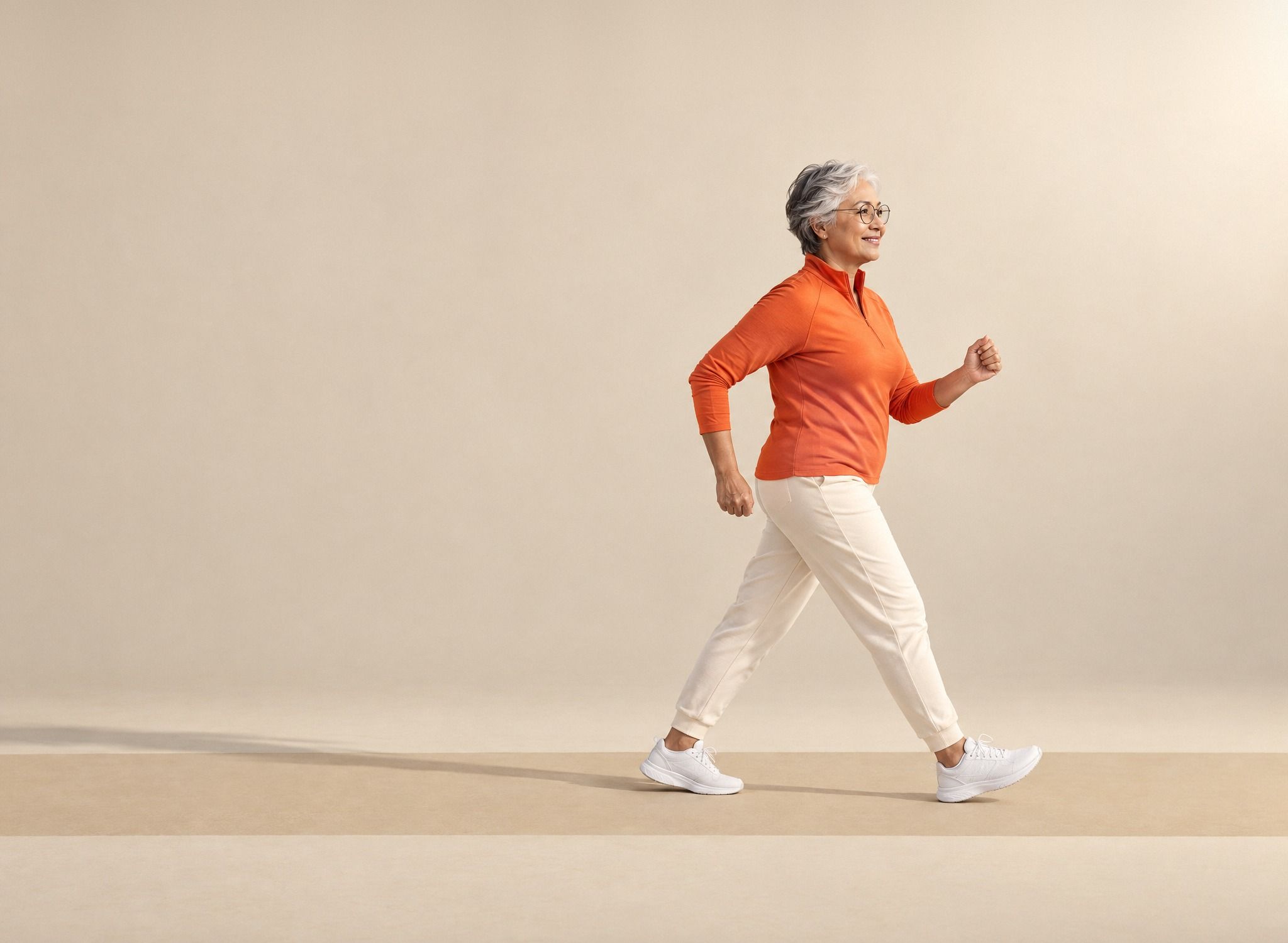
Japanese walking is interval walking with a fixed rhythm: 3 minutes of brisk walking, then 3 minutes of easy walking, repeated about five times, for 30 minutes. It comes from research at Shinshu University in Japan, where older adults who walked this way for five months improved their fitness and blood pressure more than people who walked at a steady, moderate pace.1 It’s a good way to make a walk more demanding without running. The evidence that it’s better for weight loss than other walking is limited.
What is Japanese walking?
In the studies it’s called interval walking training. Researchers led by Hiroshi Nose at Shinshu University developed it in the early 2000s as a simple way for middle-aged and older people to get the benefits of harder exercise using only walking.1 Participants alternated three minutes of slow walking with three minutes of fast walking, for at least five rounds, on four or more days a week.
The name “Japanese walking” is much newer. The method spread on social media in 2025, and search interest followed: one UK gym chain’s annual fitness report put it top of its list of rising searches, up almost 3,000% on the same months a year earlier.5
How to do Japanese walking
The whole method fits on one line: walk briskly for 3 minutes, walk easily for 3 minutes, and repeat. A full session is five rounds: 30 minutes, plus a few easy minutes to finish.
The full method: five rounds · 33 minutes
- Easy
- Brisk
Five rounds of 3 minutes easy and 3 minutes brisk, then 3 easy minutes to finish. Starting each round easy doubles as a warm-up. Diagram by Mova.
Getting the effort right
Japanese walking only works if the two speeds really are different. Use how your breathing feels rather than a number:
| Phase | How it feels | Talk test | Effort, 0–10 |
|---|---|---|---|
| Easy | Relaxed. Your breathing settles. | You can talk comfortably | 3–4 |
| Brisk | Purposeful, like you’re late. Breathing is faster. | You can talk, but not sing | 5–7 |
Brisk walking for most adults is around 3 miles (about 5 km) an hour or faster.7,8 The talk test (talk, but not sing) marks moderate effort; on a 0 to 10 scale where 0 is sitting still, moderate effort is about 5 to 6 and vigorous effort 7 to 8.8
In the original studies, the fast phase was set at about 70% of each person’s peak aerobic capacity, measured in a lab.1 That’s not 70% of your maximum heart rate, and for most people it feels somewhat hard: you can still speak, in short sentences. If “talk, but not sing” starts to feel easy, walk a little faster in the brisk minutes.
Technique for the brisk minutes
- Quicker, not longer, steps. Speed up by taking more steps, not by stretching your stride.
- Bend your arms. Let them swing naturally from the shoulder; they set the rhythm for your legs.
- Stand tall. Eyes ahead, shoulders relaxed, and roll from heel to toe.
Your first Japanese walking session
Five rounds is the target, not the starting point. If you’re new to brisk walking, begin with two rounds and an easy finish:
A first session: two rounds · 15 minutes
- Easy
- Brisk
Start easy, do two brisk phases, and finish with 3 easy minutes to cool down. Diagram by Mova.
- Choose a flat, familiar route where you can walk for 15 minutes without stopping for traffic.
- Set a timer for 3-minute blocks, or use an app that tells you when to switch.
- Start easy for 3 minutes so your body warms up.
- Brisk for 3 minutes: faster steps, arms swinging, talk-but-not-sing breathing.
- Easy for 3 minutes: slow down until your breathing settles. Don’t stop.
- Repeat once, then finish with 3 easy minutes.
If three brisk minutes feel too long, shorten them to one or two minutes and keep the easy minutes at three. Moving from a warm-up to harder intervals gradually is the advice for interval training in general.9,11
Building up over four weeks
Add a round when the current number feels comfortable, not on a fixed date. A typical path:
| Week | Rounds | Time | Sessions |
|---|---|---|---|
| 1 | 2 rounds + 3 easy minutes | 15 min | 2–3 a week |
| 2 | 3 rounds + 3 easy minutes | 21 min | 3 a week |
| 3 | 4 rounds + 3 easy minutes | 27 min | 3–4 a week |
| 4 | 5 rounds + 3 easy minutes | 33 min | 3–4 a week |
Repeat a week whenever you need to. Walk easily on the other days, or rest. In the main studies, people walked this way on at least four days a week;1 how often you walk is up to you. Five 30-minute sessions a week would add up to the 150 minutes of moderate activity a week that health guidelines recommend.10 They don’t all need to be Japanese walking.
How Japanese walking differs from interval walking
Japanese walking is interval walking, with one specific recipe. General interval walking lets you choose the length and speed of each part.
| Aspect | Japanese walking | Interval walking |
|---|---|---|
| Pattern | Always 3 min brisk, 3 min easy | Any pattern: 1/1, 2/2, 3/2, and so on |
| Harder parts | Brisk to somewhat hard, held for 3 minutes | From brisk to fast, often shorter |
| Easy parts | As long as the brisk parts | Often shorter than the hard parts once you’re fitter |
| Session | About 5 rounds, 30 minutes | Anything from 10 to 40 minutes |
| Background | A specific research programme in Japan | A general training approach |
| Best for | A simple, repeatable routine | Variety, or building toward faster walking |
What the research shows
Most of the evidence comes from one research group in Matsumoto, Japan, working with adults aged roughly 44 to 78, more of them women than men. The findings are encouraging, but they’re about fitness and blood pressure more than weight.
The original trial (2007)
246 adults with an average age of 63 were split into three groups for five months: no training, moderate steady walking, or interval walking (at least five rounds of 3 minutes fast and 3 minutes slow, on four or more days a week).1 The interval group improved most: aerobic fitness rose by about 8 to 9%, thigh strength by 13 to 17%, and systolic blood pressure fell by about 9 mmHg, more than in the steady-walking group. Only people who reached their training targets were included in the final analysis, and up to 30% of participants dropped out, which may make the results look better than they would for everyone.
Larger follow-ups (2011 and 2019)
A study of 666 people who did four months of interval walking found improvements in fitness and leg strength, and reductions in weight, body mass index, body fat, blood pressure and blood sugar, with the biggest changes in the least fit people.2 It had no comparison group, so some change could have happened anyway. A 2019 analysis of 679 participants found that improvements grew with the amount of fast walking each week and levelled off at around 50 minutes of fast walking a week.3
A study in type 2 diabetes (2013)
In a small Danish trial with 32 people with type 2 diabetes, interval walking (3 minutes slower, 3 minutes faster, an hour at a time, five times a week) improved fitness, blood sugar control and body fat, while steady walking that used the same energy did not.4 It’s promising, but too small to generalise from.
Popular claims, checked
| Claim | What the evidence says |
|---|---|
| “It improves fitness and blood pressure” | Supported in middle-aged and older Japanese adults, compared with steady moderate walking.1 |
| “It’s better for weight loss than normal walking” | Not established. Weight fell in an uncontrolled study2 and in one small trial in type 2 diabetes,4 but the main trial wasn’t designed to test weight loss. |
| “It targets belly fat” | Not shown. No study has shown fat loss from a particular part of the body. |
| “It replaces 10,000 steps” | Not tested. The studies compared it with steady walking, not with step goals. A 30-minute session is still only part of a day’s walking. |
| “Anyone can do it” | Mostly. It’s still walking, but the brisk phases are harder than a stroll. Start with fewer rounds and build up. |
Weight loss depends on your overall activity and on what you eat, and popular write-ups of the method say the same.6 Our guide to walking for weight loss covers that in more detail.
Who should take care
Japanese walking is walking, so it suits most people who can walk briskly for a few minutes. Take more care, and talk to a doctor first, if you have a heart condition, high blood pressure that isn’t controlled, a recent injury, or if you haven’t been active for a long time. Interval training advice from the Mayo Clinic suggests building a regular walking habit for at least two weeks before adding intervals if you’re new to exercise.9
Common questions
Do I start with the brisk or the easy part?
Either works. Starting easy gives you a built-in warm-up, which is why our diagrams begin with an easy phase. If you start brisk, walk easily for a few minutes first.
Can I do Japanese walking on a treadmill or at home?
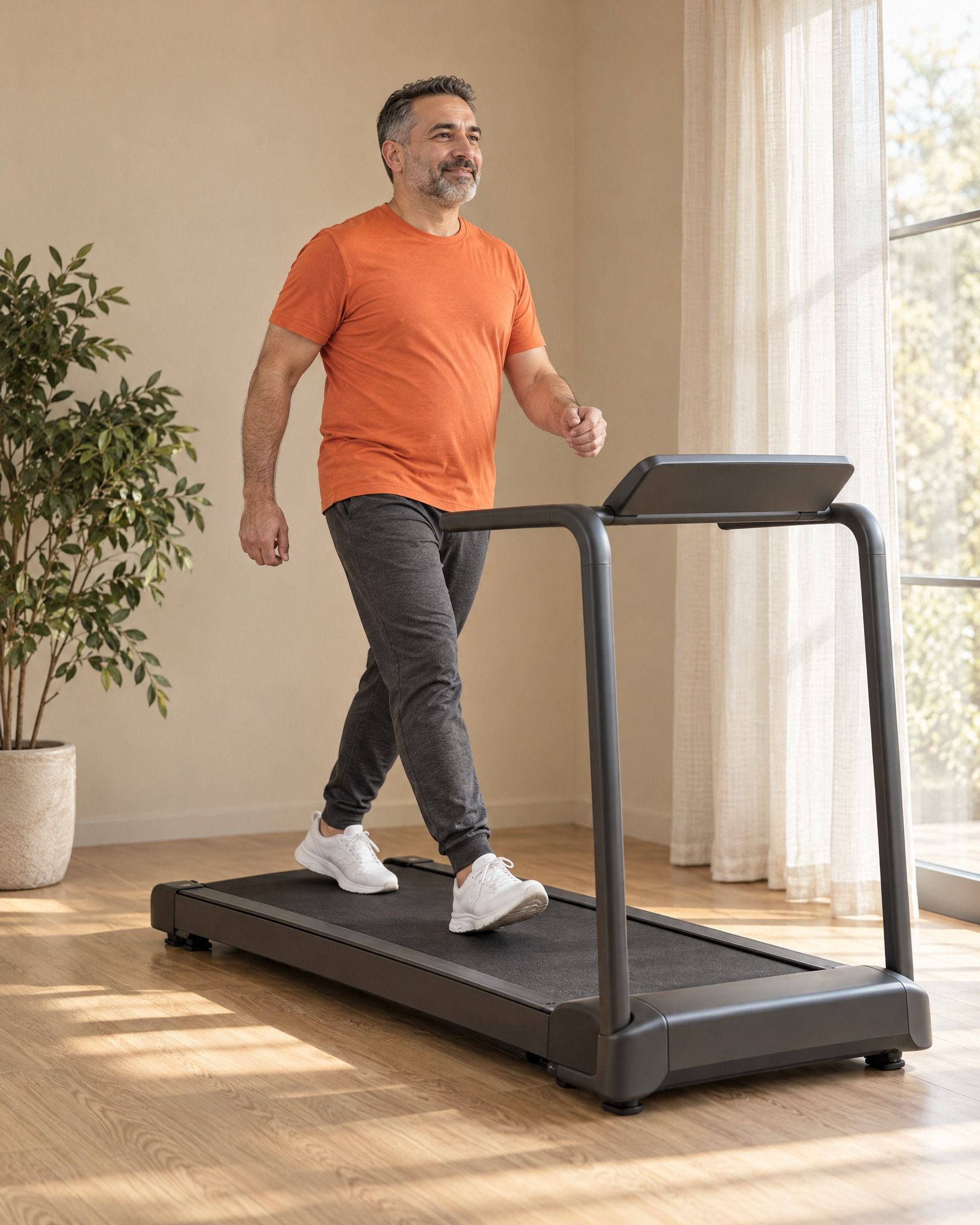
Yes. On a treadmill, change the speed every three minutes (see our treadmill guide). At home, march briskly on the spot for the brisk minutes and step gently for the easy ones (see indoor walking).
How often should I do it?
In the studies, people did at least four sessions a week. Two or three sessions a week, with easy walks on other days, is a sensible place to start.
Is Japanese walking good for beginners?
Yes, if you start with fewer rounds. If you’re completely new to walking for exercise, spend a couple of weeks building a regular habit with our beginner walking plan first.
Sources
- Effects of high-intensity interval walking training on physical fitness and blood pressure in middle-aged and older people. Nemoto K et al., Mayo Clinic Proceedings, 2007.
- Physical fitness and indices of lifestyle-related diseases before and after interval walking training in middle-aged and older males and females. Morikawa M et al., British Journal of Sports Medicine, 2011.
- High-intensity walking time is a key determinant to increase physical fitness and improve health outcomes after interval walking training in middle-aged and older people. Masuki S, Morikawa M, Nose H, Mayo Clinic Proceedings, 2019.
- The effects of free-living interval-walking training on glycemic control, body composition, and physical fitness in type 2 diabetic patients: a randomized, controlled trial. Karstoft K et al., Diabetes Care, 2013.
- UK Fitness Report 2025/26. PureGym, 2025. Search-interest figures for “Japanese walking”.
- What Is the Japanese Walking Method?. WebMD, 2025.
- Walking for health. NHS.
- Measuring Physical Activity Intensity. US Centers for Disease Control and Prevention.
- Interval training for heart health. Mayo Clinic News Network, 2023.
- Physical activity guidelines for adults aged 19 to 64. NHS.
- Warm Up, Cool Down. American Heart Association.