Walking method8 min read
Indoor Walking Workouts You Can Try at Home
No treadmill, no problem. Marching on the spot, step touches and tap backs turn a small patch of floor into a walking workout. Here’s how to do each move and a 15-minute routine to start with.
The short answer
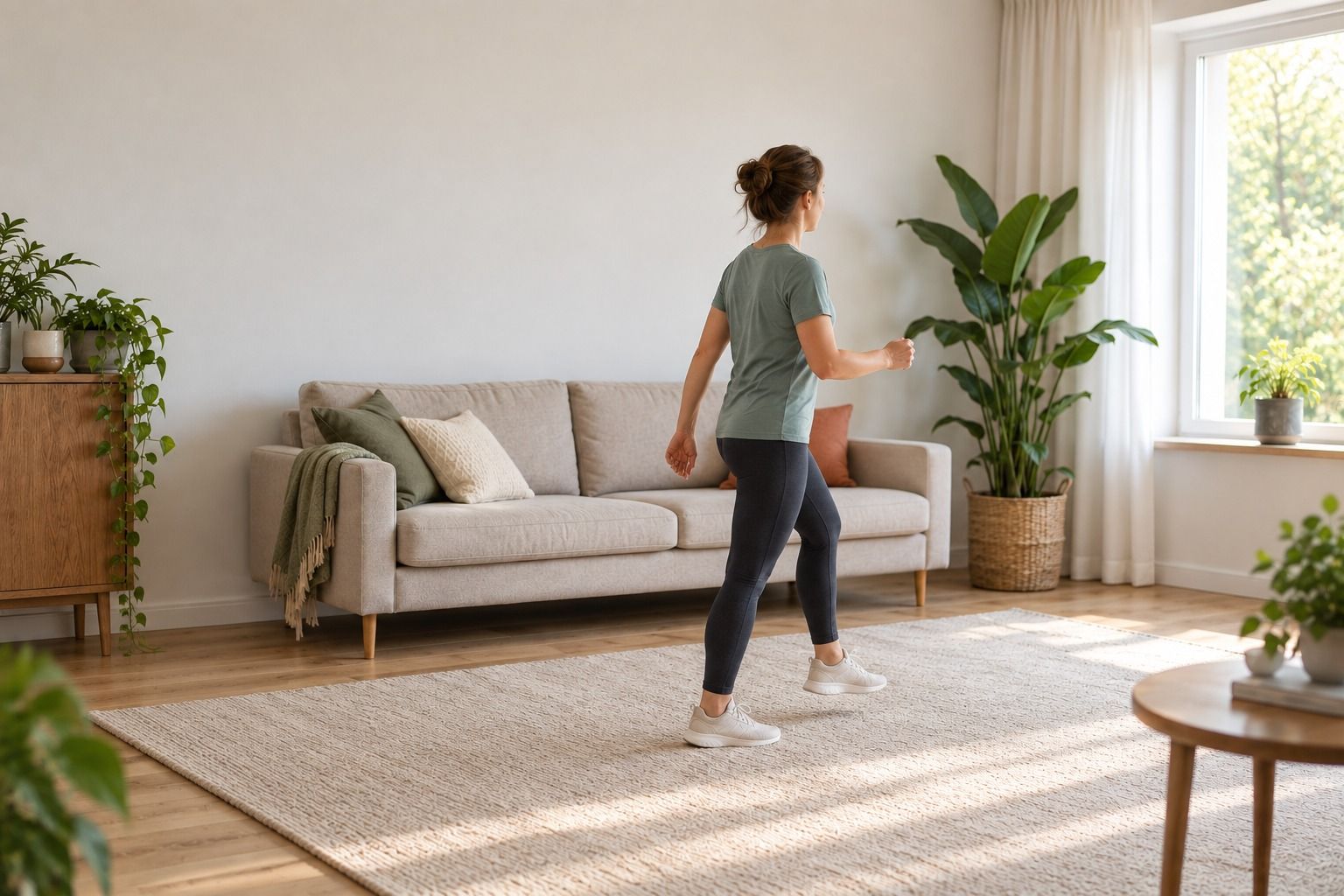
Indoor walking is walking-style movement on the spot or in a small space: marching, stepping side to side and tapping back, with your arms swinging. Done briskly, marching on the spot is a moderate-intensity activity, close to a brisk outdoor walk.1 You need about two square metres of clear floor, supportive shoes and a chair nearby to hold if you need it.
Does walking at home count?
Yes. What matters for your health is how much you move and how hard, not where. Researchers who catalogue the energy cost of activities rate marching on the spot at a moderate pace at about 4.5 METs (multiples of your resting energy use), similar to brisk walking outdoors at about 4.8; rapid marching is rated much higher.1 Short home sessions count too: the NHS suggests 10-minute home workouts a few times a week as one way toward the recommended 150 minutes.2,5 And when the weather is bad, walking indoors is an easy swap.3
Set up your space
- Clear a patch of floor about the size of a large rug, with an arm’s length of space around you.
- Choose a stable surface. Avoid loose rugs and slippery floors; a firm floor or a flat, fixed carpet is best.
- Wear supportive shoes that fit well, with non-slip soles,3 rather than socks or slippers.
- Keep a sturdy chair or a kitchen counter close by to hold for balance.
- Prop up your phone or a timer where you can see it, open a window if the room is warm, and keep water nearby.
Six indoor walking moves
These are the same moves Mova uses in its indoor sessions. Start each one slowly, then find a rhythm.
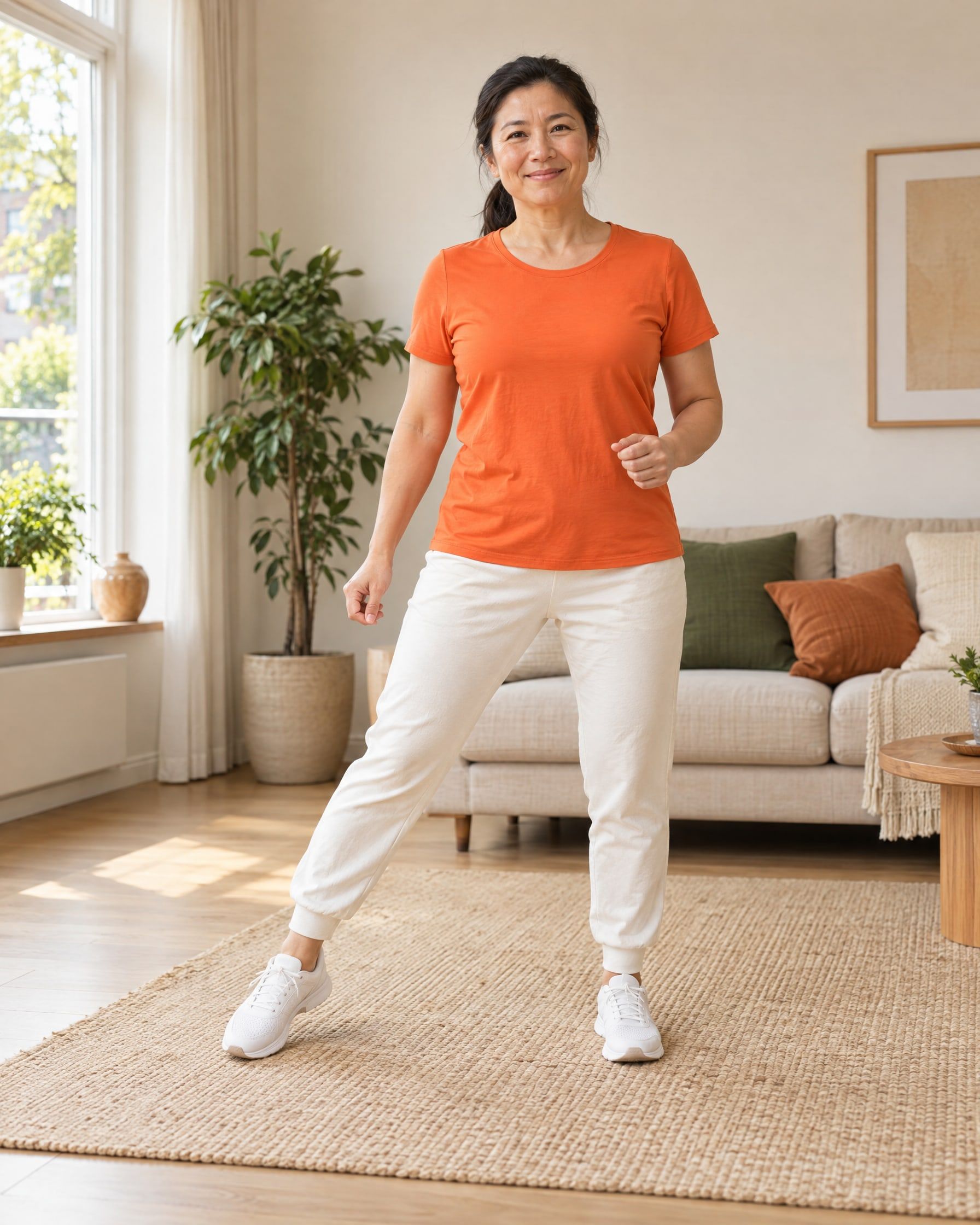
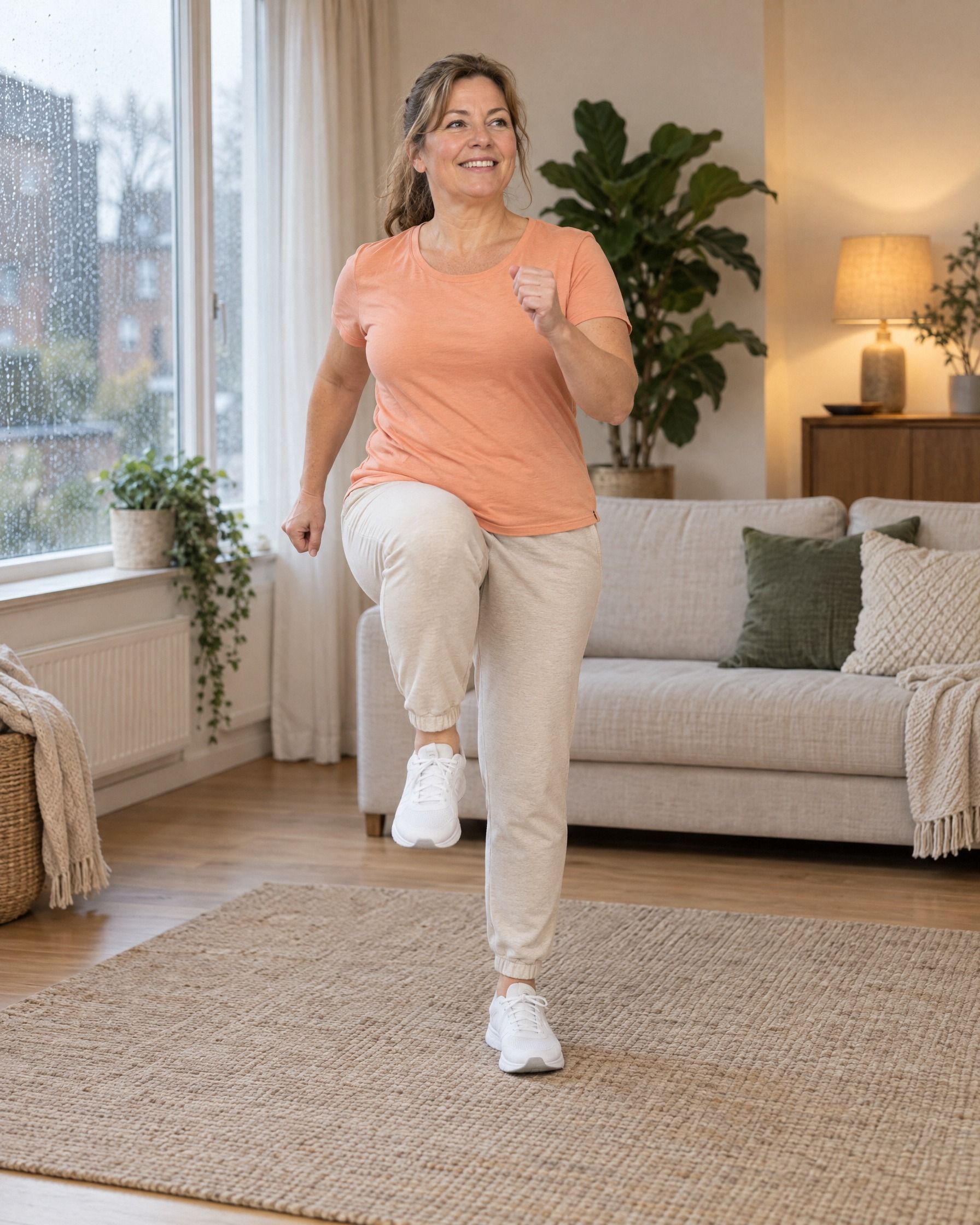
March in place
Stand tall. March on the spot, swinging your arms as you would when walking, and land softly.
Easier: lift your heels only and keep your toes down.
Step touch
Step to the side, bring the other foot in to touch, then go the other way. Let your arms swing or bend them at your sides.
Easier: make the step smaller and keep your hands on your hips.
Tap back
Step one foot back and tap the toes on the floor, bring it in, and swap feet. Keep your chest up.
Easier: hold a chair or counter while you tap back.
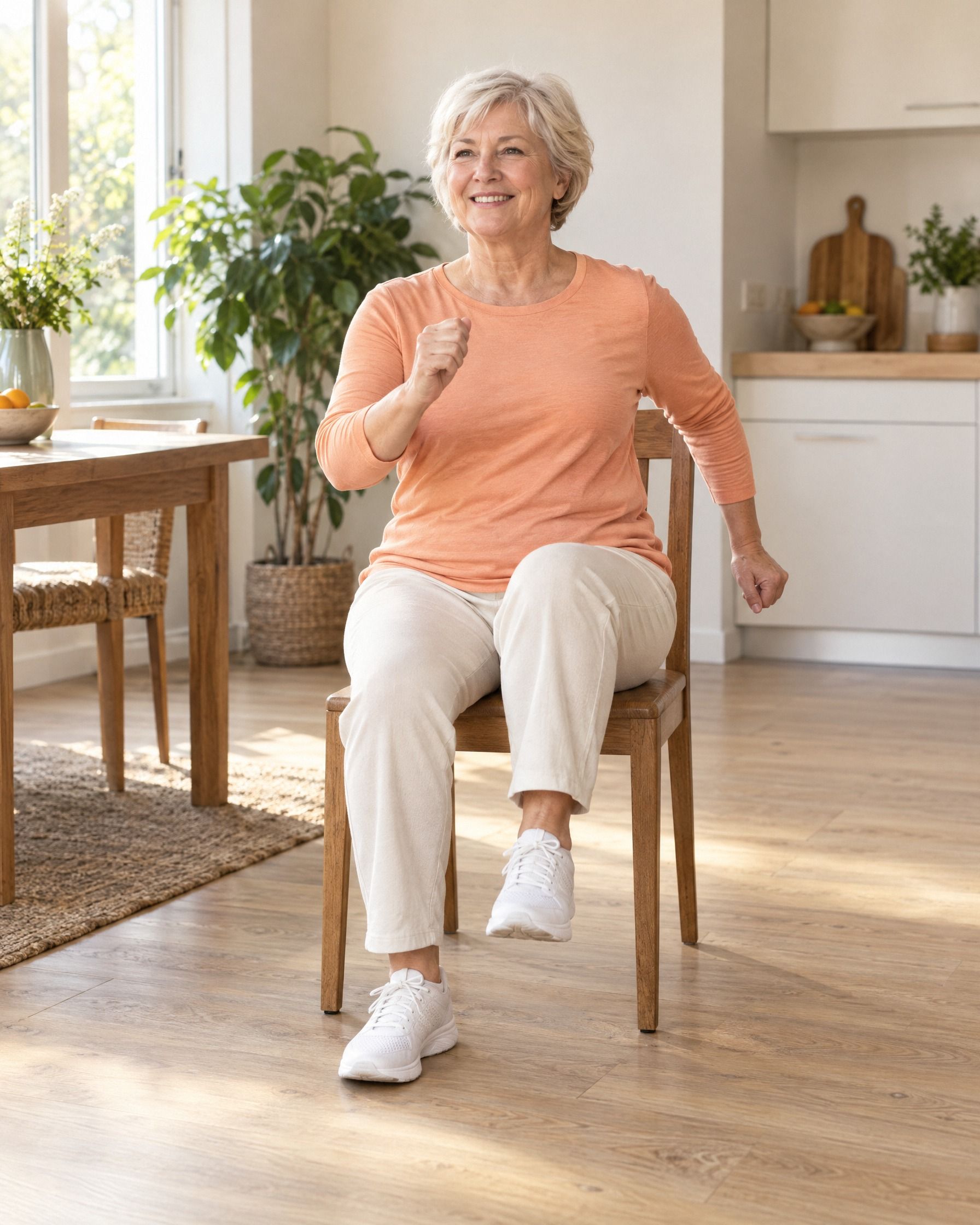
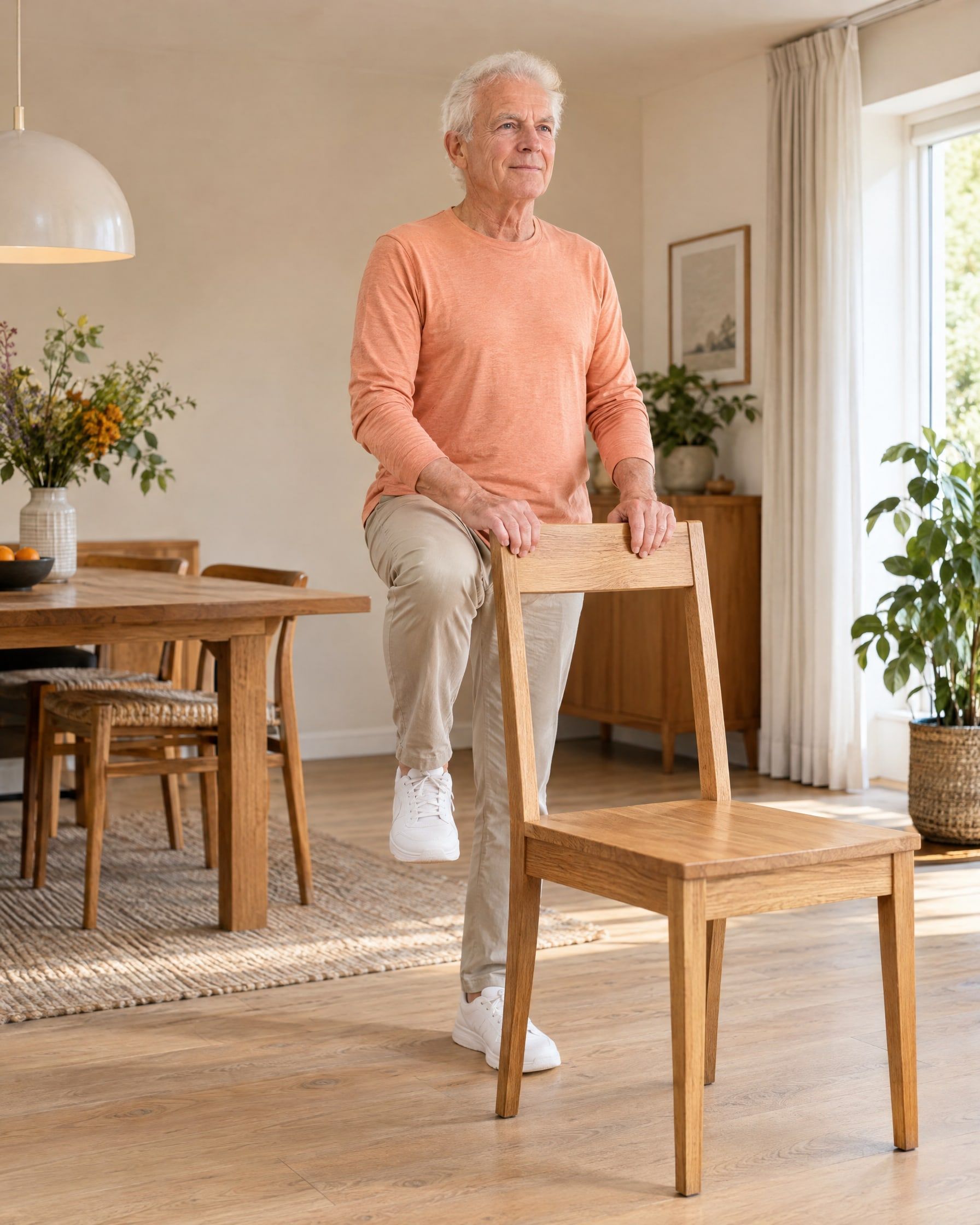
Supported march
Stand behind a sturdy chair and hold the back. March on the spot, standing tall with your eyes forward.
Easier: lift your heels only, or sit and march seated.
Supported side step
Hold the chair back with both hands. Step one foot out to the side and back, then swap sides.
Easier: make the step smaller, or sit and do it seated.
Standing stretch
Reach both arms up and breathe in, lower them slowly and breathe out, then roll your shoulders. Use it to finish.
Easier: sit down and do the stretch seated.
A 15-minute starter routine
15 minutes at home · 15 minutes
- Easy
- Steady
- Brisk
Easy marching to warm up, two short brisk blocks, and a slow finish. Diagram by Mova.
| Minutes | Move | Effort |
|---|---|---|
| 0–3 | March in place, small and relaxed | Easy |
| 3–5 | Step touch | Steady |
| 5–7 | March in place: higher knees, bigger arm swing | Brisk |
| 7–9 | Tap back | Steady |
| 9–11 | March in place, brisk again | Brisk |
| 11–13 | Step touch | Steady |
| 13–15 | Slow march, then the standing stretch | Easy |
Brisk means you can talk but not sing.6 Starting and finishing gently gives your body time to warm up and settle.7 Do the routine two or three times in your first week.
Make it easier or harder
| To make it easier | To make it harder |
|---|---|
| Hold the chair for every move (supported march and side step) | Lift your knees higher and swing your arms more in the brisk blocks |
| Keep the whole routine at an easy pace | Make the brisk blocks 3 minutes |
| Do 10 minutes and stop | Go round twice for 30 minutes |
| Switch to chair walking on a low-energy day | Try Japanese walking on the spot: 3 minutes brisk, 3 minutes easy |
Fitting it into your day
- Use the in-between moments: march while the kettle boils, during a phone call, or through an episode of a show.
- Break it up: three 10-minute sessions count as much as one 30-minute session toward your weekly total.5
- Every bit helps: some activity is better than none, and replacing sitting time with movement of any intensity has benefits.4
Safety
Indoor walking is gentle on the joints, but take care with balance: keep a chair or counter within reach, and use the supported moves if you feel unsteady. Stop if you feel dizzy or unwell.
Sources
- 2024 Adult Compendium of Physical Activities: walking. Compendium of Physical Activities, 2024.
- Home workout videos. NHS Better Health.
- Tips for Getting and Staying Active as You Age. US National Institute on Aging.
- World Health Organization 2020 guidelines on physical activity and sedentary behaviour. Bull FC et al., British Journal of Sports Medicine, 2020.
- Physical activity guidelines for adults aged 19 to 64. NHS.
- Measuring Physical Activity Intensity. US Centers for Disease Control and Prevention.
- Warm Up, Cool Down. American Heart Association.