Walking method8 min read
Interval Walking: A Beginner's Guide
Alternate harder and easier stretches of walking to get more from the same time, without running. What each effort level feels like, three sessions to start with, and how to build from there.

The short answer
Interval walking means switching between faster and easier walking in a planned pattern, for example 1 minute fast, 1 minute easy, repeated. The faster parts raise your effort; the easier parts let you recover so you can go again. Start with a warm-up, keep the fast parts short at first, and finish with a few easy minutes.1,6
What is interval walking?
A steady walk keeps the same pace from start to finish. An interval walk changes pace on purpose: a short stretch of faster walking, then a stretch of easier walking, repeated several times. You can do it anywhere you’d normally walk, and you don’t need to run.
Mixing in faster walking is a simple way to make a walk more demanding and to build toward a faster everyday pace.7 In studies of exercise for weight management, higher-intensity exercise led to slightly more weight loss than lower-intensity exercise, about 1.5 kg on average, but the bigger factors were how much people did and whether they changed their diet too.8
Easy, steady, brisk and fast: what they feel like
You don’t need a heart-rate monitor. Your breathing is a reliable guide, and the talk test is the one most health organisations use.2,5
| Level | Talk test | Effort, 0–10 | Use it for |
|---|---|---|---|
| Easy | You can chat comfortably | 2–4 | Warm-up, recovery, cool-down |
| Steady | Full sentences, breathing a little quicker | 4–5 | Settling in after the warm-up |
| Brisk | You can talk, but not sing | 5–6 | Longer working parts |
| Fast | Only a few words at a time | 7–8 | Short working parts |
On a 0 to 10 scale, moderate effort is about 5 to 6 and vigorous effort about 7 to 8.2 On the 6 to 20 Borg scale some clinics use, moderate effort is roughly 12 to 14, “somewhat hard”.3 If you count steps, about 100 steps a minute is a common marker of moderate-intensity walking in adults, and about 130 of vigorous walking.4 All of these are guides; how it feels to you matters most.
Before you start
- Walk regularly first. If you’re new to exercise, the Mayo Clinic suggests walking regularly for at least two weeks before adding intervals.1 Our beginner walking plan is one way to do that.
- Pick a route without interruptions. Traffic lights in the middle of a fast stretch are frustrating. A park loop, a path or a treadmill works well.
- Always warm up and cool down. Five minutes or so of easier walking at each end lets your heart rate rise and settle gradually.6
Three starter sessions
Each session starts easy and ends easy. Move to the next one when the current one feels manageable, not before.
1. First intervals: 1 minute fast, 1 minute easy (15 minutes)
First intervals · 15 minutes
- Easy
- Fast
3 minutes easy, then 4 rounds of 1 minute fast and 1 minute easy, then 4 minutes easy. Diagram by Mova.
Short fast parts let you learn the rhythm without getting out of breath. If one minute is too long, start with 30 seconds.
2. Building up: 2 minutes fast, 2 minutes easy (30 minutes)
Two-minute intervals · 30 minutes
- Easy
- Steady
- Fast
5 minutes to warm up, then 5 rounds of 2 minutes fast and 2 minutes easy, then 5 minutes easy. Diagram by Mova.
The fast parts are now long enough that pacing matters. Start each one at a pace you could hold for all two minutes.
3. Longer efforts: 3 minutes fast, 2 minutes easy (40 minutes)
Three-minute intervals · 40 minutes
- Easy
- Steady
- Fast
5 minutes to warm up, then 6 rounds of 3 minutes fast and 2 minutes easy, then 5 minutes easy. Diagram by Mova.
Recoveries are now shorter than the fast parts, so this is a harder session. Save it for a day when you feel fresh, and walk easily the next day.
How to progress
Change one thing at a time, and only when a session feels manageable:
- Add a round (for example, from 4 to 6).
- Lengthen the fast parts (1 minute, then 2, then 3).
- Shorten the easy parts once the fast parts are comfortable.
Two or three interval walks a week, with easy walks or rest in between, is plenty. Together with your other walking, it counts toward the 150 minutes of moderate activity a week that guidelines recommend.9
Outdoors, on a treadmill or at home
- Outdoors: use landmarks (lamp posts, benches) or a timer. A gentle hill makes a natural fast part. See outdoor walking for route and safety tips.
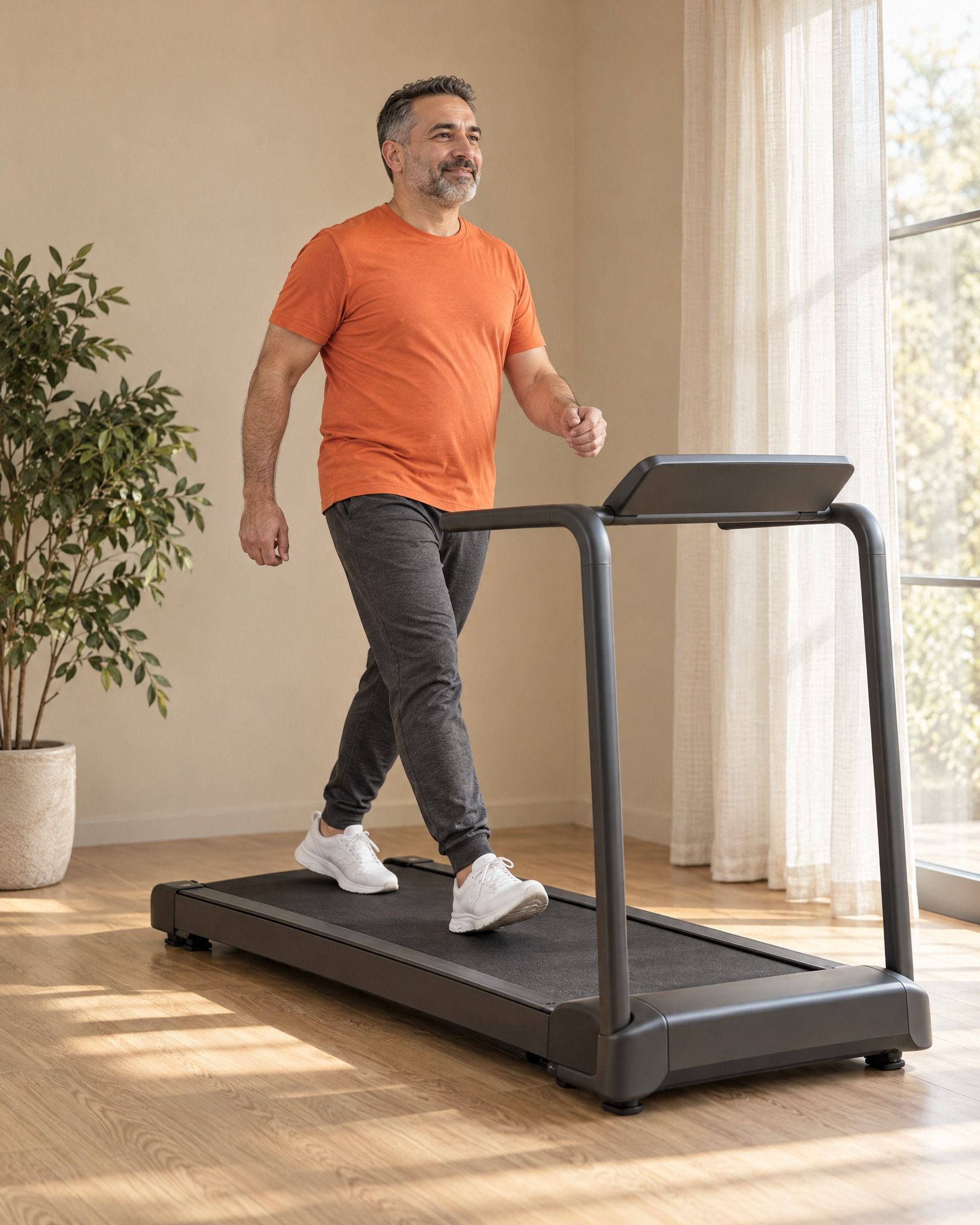
- On a treadmill: change the speed for each part, and give the belt a few seconds to catch up. See treadmill walking.
- At home: march briskly on the spot, lifting your knees and swinging your arms, for the fast parts, and step gently for the easy parts. See indoor walking.
How interval walking differs from Japanese walking
Japanese walking is one particular interval pattern: always 3 minutes brisk and 3 minutes easy, about five times. It comes from a specific research programme in Japan. Interval walking is the general idea, so you can choose shorter, faster parts or different recoveries. If you like a single, simple routine, Japanese walking is a good choice. If you like variety, or want to build toward faster walking, general intervals give you more options.
Safety
Fast walking still shouldn’t make you feel unwell. If you have a heart condition, high blood pressure or another health condition, check with your care team before you start interval training.1 Slow down if you can’t speak at all, and don’t push through pain.
Sources
- Interval training for heart health. Mayo Clinic News Network, 2023.
- Measuring Physical Activity Intensity. US Centers for Disease Control and Prevention.
- Rated Perceived Exertion (RPE) Scale. Cleveland Clinic.
- Walking cadence (steps/min) and intensity in 21–40 year olds: CADENCE-adults. Tudor-Locke C et al., International Journal of Behavioral Nutrition and Physical Activity, 2019.
- Walking for health. NHS.
- Warm Up, Cool Down. American Heart Association.
- Walking: Trim your waistline, improve your health. Mayo Clinic.
- Exercise for overweight or obesity. Shaw K et al., Cochrane Database of Systematic Reviews, 2006.
- Adult Activity: An Overview. US Centers for Disease Control and Prevention.