Walking method8 min read
Treadmill Walking for Beginners
A treadmill takes the weather, the traffic and the dark out of walking. Here’s how to get on safely, find a speed that suits you, use incline sensibly, and three sessions to start with.
The short answer
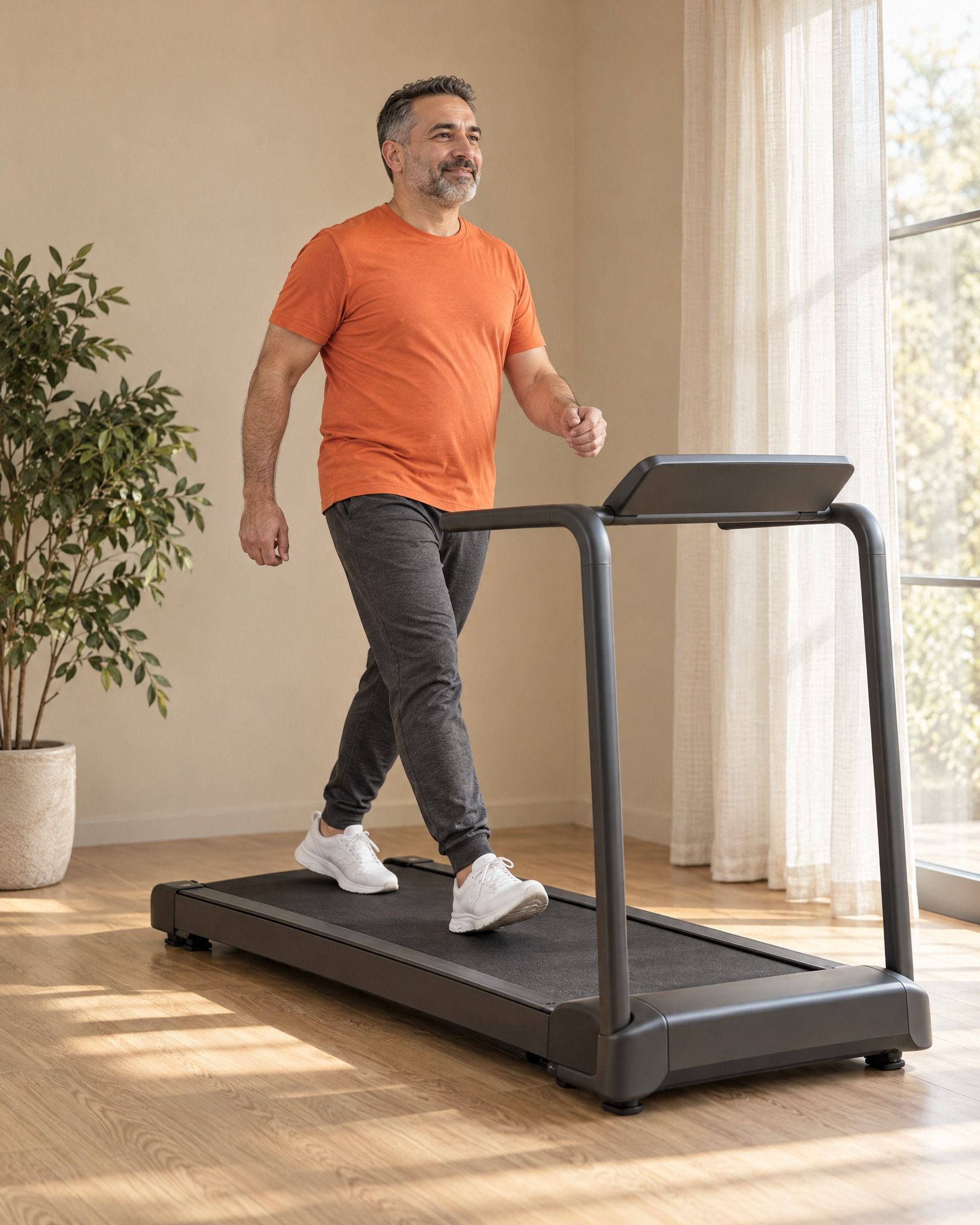
Clip on the safety key, stand with your feet on the side rails, start the belt at its slowest speed and step on. Walk easily for about 5 minutes, then raise the speed until you can talk but not sing. Keep the incline low at first, and add it gradually once you’re comfortable. Slow down before you stop, and never step off a moving belt.1,3
Getting on and off safely
Treadmills are safe when used carefully, but falls do happen: one analysis estimated more than 450,000 treadmill injuries treated in US emergency departments between 2000 and 2022, most of them at home.2 These habits prevent most of them:1
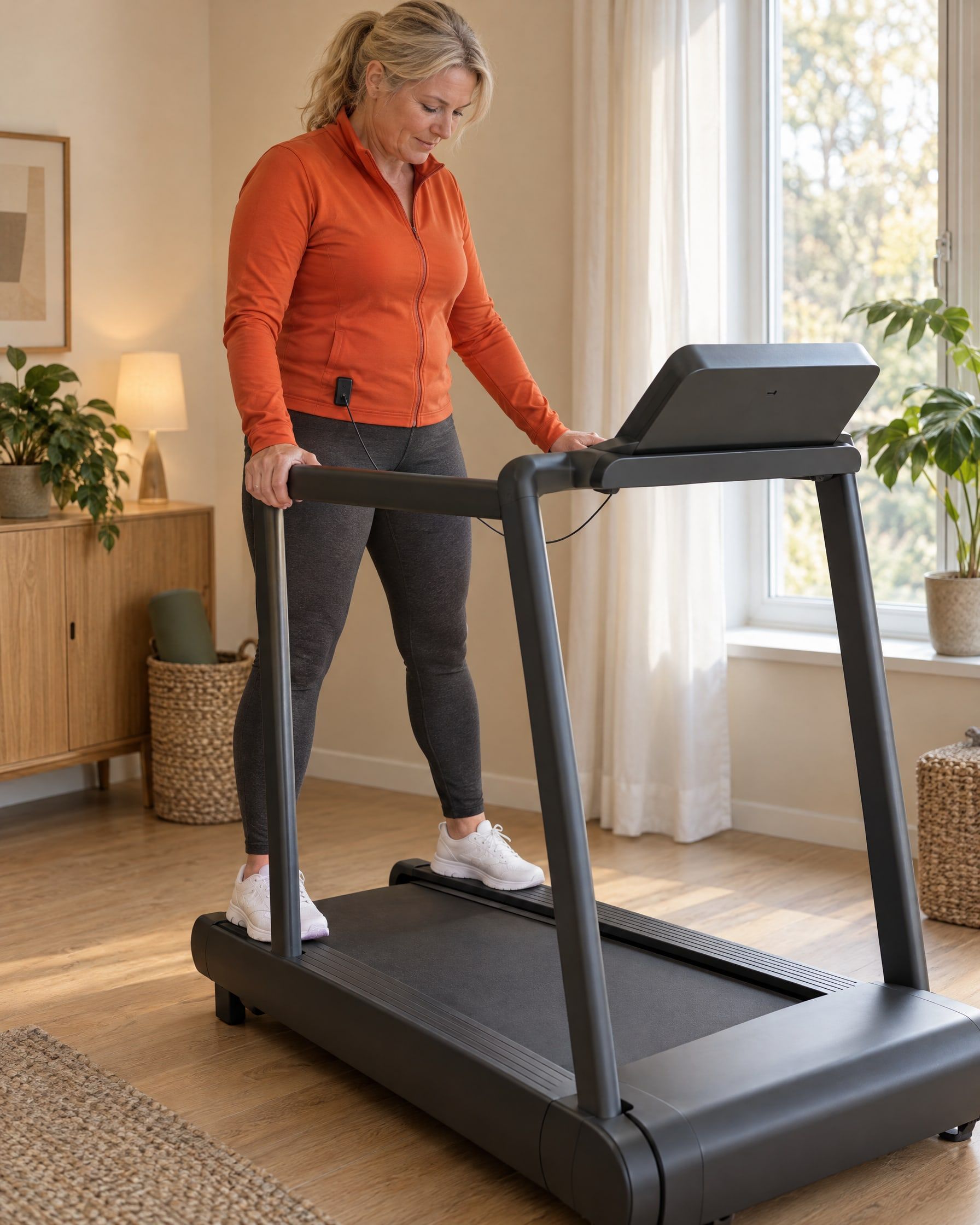
- Clip the safety key to your clothing so the belt stops if you slip back.
- Straddle the belt, feet on the side rails, before you start it.
- Start at the lowest speed, hold the handrail lightly, and step on once the belt is moving.
- Build speed gradually over the first few minutes.
- To finish, slow the belt right down and wait for it to stop before stepping off. Never step off a moving belt.
- Leave space around the machine: about 2 feet (60 cm) on each side and 6 feet (2 m) behind it, and keep children and pets away.
Choosing your speed
Use effort, not the number on the display. The right speed depends on your height, fitness and even the machine.
| Pace | Talk test | Many people start around |
|---|---|---|
| Easy | You can chat comfortably | 3–4.5 km/h (2–2.8 mph) |
| Steady | Full sentences, breathing a little quicker | 4.5–5 km/h (2.8–3.1 mph) |
| Brisk | You can talk, but not sing | 5–6.5 km/h (3.1–4 mph) |
Brisk walking for most adults is about 3 miles (5 km) an hour or faster;5,6 on a 0 to 10 effort scale, that’s about 5 to 6.6 Some people find walking on a belt feels faster than the same speed outside. If the pace makes you hold on tightly, it’s too fast for now.
Using incline
Raising the incline makes walking harder without going faster, and works your leg muscles more.3 A few points help:
- Start flat, or at a gentle 1%. You may hear that 1% “matches walking outside”. The study behind that tip measured runners, not walkers,4 so use whatever feels comfortable.
- Add 1% at a time, and slow down a little if your breathing rises above talk-but-not-sing.
- Don’t hang on to the handrails. Hold them lightly for balance if you need to,3 but leaning on them takes the work out of the incline. If you need to grip, lower the incline or the speed.
Good form on the belt
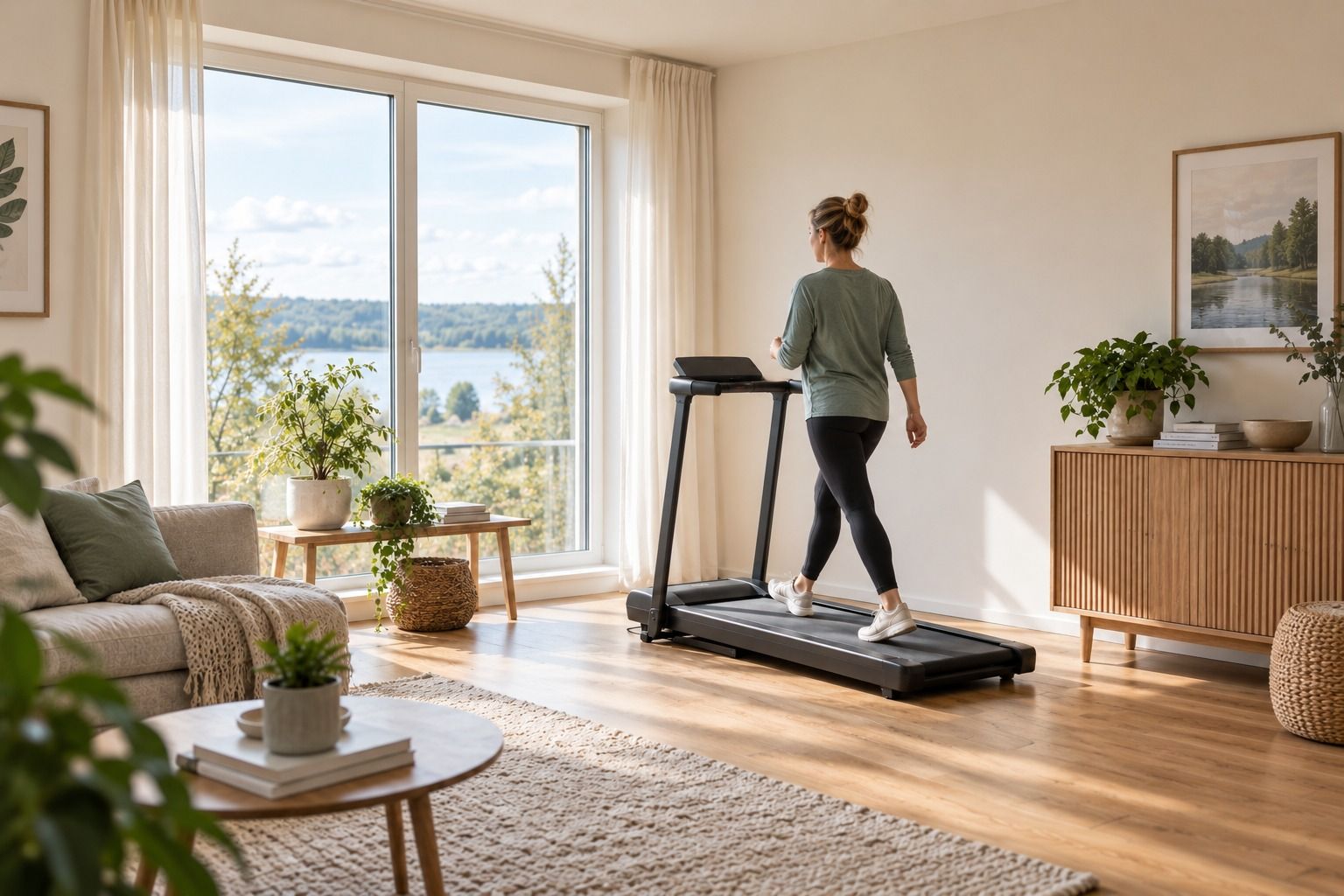
- Look ahead, not down at your feet or the display.1
- Walk in the middle of the belt, close enough to the console to reach the controls without stretching.
- Swing your arms naturally and take normal-length steps.
- Keep your phone or tablet still, on the console rather than in your hand.
Three beginner sessions
Every session starts and ends with a few easy minutes, which lets your heart rate rise and settle gradually.7,3
1. Find your pace (20 minutes, flat)
Easy flat walk · 20 minutes
- Easy
- Steady
3 minutes easy, 14 minutes at a steady pace you could keep up all day, 3 minutes easy. Diagram by Mova.
Use this session to learn the controls and find a steady speed. Note it down for next time.
2. First brisk walk (30 minutes, flat)
Brisk treadmill walk · 30 minutes
- Easy
- Brisk
5 minutes easy, 20 minutes brisk, 5 minutes easy. Diagram by Mova.
Raise the speed slowly over the first minute of the brisk block. If 20 minutes is too long, do two 8-minute brisk blocks with 4 easy minutes between.
3. First incline walk (25 minutes)
| Minutes | Incline | Speed |
|---|---|---|
| 0–5 | Flat or 1% | Easy, warming up |
| 5–8 | 2% | Steady |
| 8–11 | 3% | Steady |
| 11–14 | 4% | Steady, slow a little if needed |
| 14–19 | 5% | Steady: talk, but not sing |
| 19–21 | 3% | Steady |
| 21–25 | Flat or 1% | Easy, cooling down |
Keep the speed the same while the incline rises, unless your breathing tells you to slow down. Stop at a lower incline if 5% feels too steep.
What to try next
- Intervals: 1 or 2 minutes faster, then the same easier, repeated. See interval walking.
- Japanese walking: change the speed every 3 minutes between brisk and easy. See Japanese walking.
- Longer walks: add 5 minutes at a time toward 30 to 45 minutes. Five 30-minute walks a week add up to the 150 minutes guidelines recommend.8
Safety
Keep water within reach, wear proper trainers (not socks or bare feet), and stop the belt before you adjust clothes or reach for things. If you feel unsteady, slow down and hold the handrails.
Sources
- How to stay safe on a treadmill. Consumer Reports, 2021.
- Treadmill-related injuries treated in US emergency departments, 2000–2022. Forrester MB, Lower Extremity Review, 2024.
- Get smart about treadmills. Harvard Health Publishing, 2017.
- A 1% treadmill grade most accurately reflects the energetic cost of outdoor running. Jones AM, Doust JH, Journal of Sports Sciences, 1996.
- Walking for health. NHS.
- Measuring Physical Activity Intensity. US Centers for Disease Control and Prevention.
- Warm Up, Cool Down. American Heart Association.
- Adult Activity: An Overview. US Centers for Disease Control and Prevention.