Routine8 min read
How to Build a Walking Habit That Lasts
Motivation comes and goes; habits stay. Here’s what research on habit formation suggests about turning walking into something you do without having to decide, and how to keep going when a week goes wrong.
The short answer
Walk at the same time and in the same situation each day, for example straight after breakfast. Start with a walk so short it’s hard to say no to, plan what you’ll do on bad days, and keep a simple record. In one well-known study, new daily habits took about 66 days on average to become automatic, with a wide range between people, and missing a single day didn’t set people back.1,3
How long does a habit take?
In a study at University College London, 96 volunteers each picked a new daily behaviour, such as eating fruit at lunch or running before dinner, and reported every day how automatic it felt. On average it took about 66 days to reach a plateau, but the range ran from 18 to 254 days.1,2 Exercise habits tended to take longer than eating or drinking habits.
Two findings are especially useful. A habit grows fastest in the early weeks, so the first month counts most. And missing one opportunity didn’t meaningfully affect the process.1 You don’t need a perfect streak.
1. Tie walking to a cue
Habits form when you repeat an action in the same context: the same time, place or preceding activity.3 Choose a cue that happens every day anyway:
- After your morning coffee
- When you get home from work, before you sit down
- After lunch, or after dinner
- When you drop the children at school
The cue matters more than the time on the clock. “After dinner” works even if dinner moves around.
2. Make an if-then plan
Psychologists call these implementation intentions: a specific plan of the form “When situation, I will action.” Across many studies they’ve had a medium-to-large effect on people following through on their goals.4 For physical activity specifically, the effect is smaller but still useful.5
- “When I’ve finished breakfast on weekdays, I’ll walk to the park and back.”
- “When it’s raining at 6pm, I’ll do a 15-minute indoor walk instead.”
- “When I get off the train, I’ll take the long way home.”
3. Start smaller than you think
A 10-minute walk you do every day builds the habit faster than a 45-minute walk you do now and then. Once walking at your cue feels automatic, make the walk longer; that’s much easier than starting a long walk from scratch. Our 4-week beginner plan starts at 10 minutes for this reason.
4. Make it easy to start
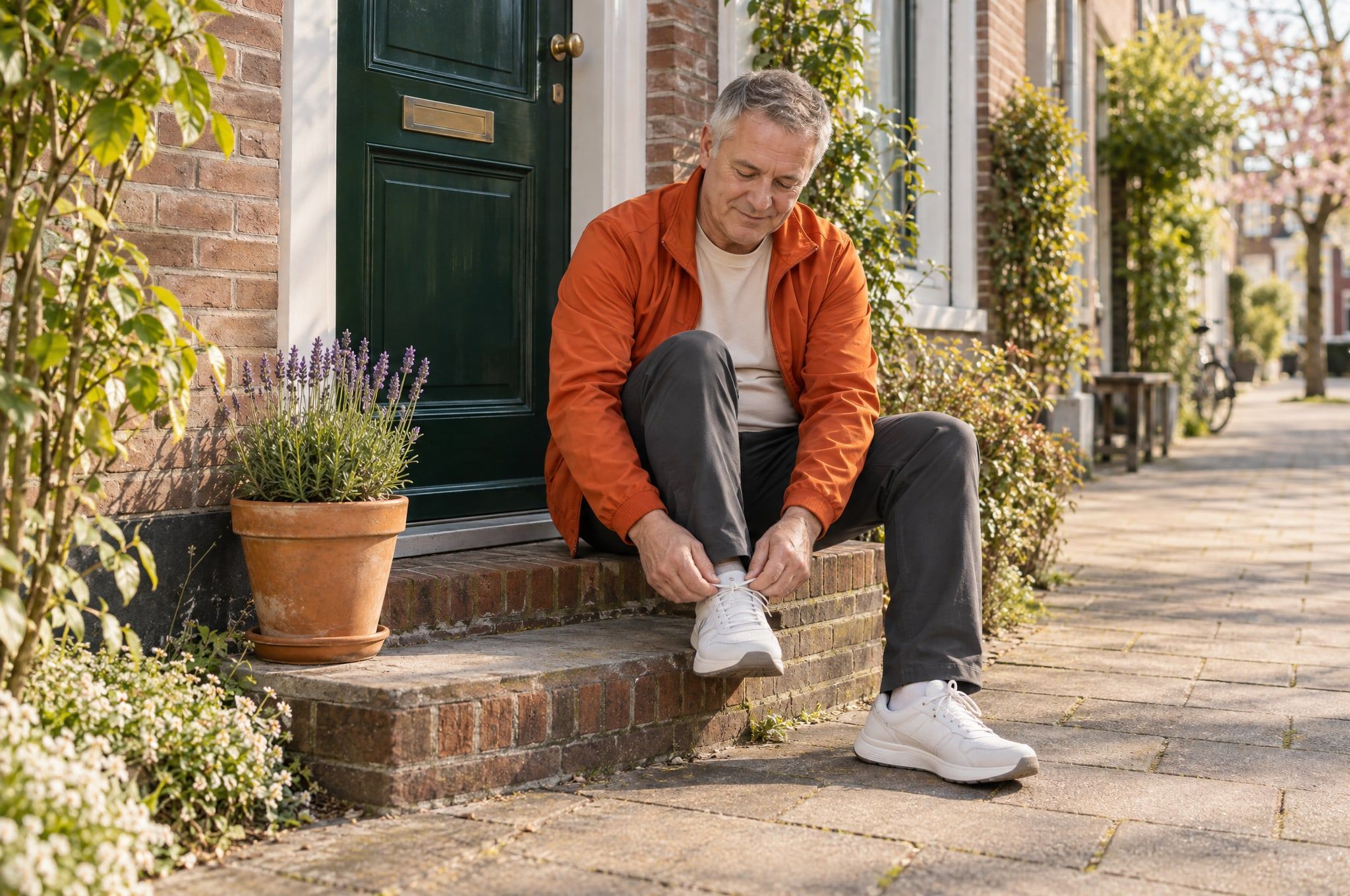
- Leave your shoes by the door and a jacket on the hook.
- Decide your route in advance, so there’s nothing to think about.
- Remove small obstacles: charge your headphones, keep an umbrella handy.
- Walk with someone if company helps, or use the walk for a phone call.
- Make it pleasant: a route you like, a podcast you save for walks, a coffee at the halfway point.
5. Keep track
Self-monitoring, keeping a record of what you do, is one of the techniques most consistently linked with success in physical activity programmes, especially combined with goal setting and reviewing progress.6 Step counters work partly this way: in a review of pedometer studies, people walked about 2,500 more steps a day, and having a step goal was a key ingredient.7
Keep it simple: a calendar tick, your phone’s step count, or an app. Look back at the end of each week, and notice what helped.
6. Plan for bad days
| If… | Then… |
|---|---|
| It’s raining or icy | Do an indoor walk or a treadmill walk of the same length |
| You’re short of time | Walk for 10 minutes. Short walks count toward your weekly total.9 |
| You’re tired | Walk at an easy pace, or do 5 minutes and decide then |
| Your joints ache | Try chair walking or a shorter, flatter route |
| Your routine changes | Pick a new cue for the new routine, such as after lunch instead of after work |
The point of a back-up plan is to keep the cue and the action together, even when the walk itself is smaller. Some activity is better than none.8
Restarting after a break
Holidays, illness and busy weeks happen. When you come back:
- Start shorter and easier than where you left off, especially after an illness.
- Go back to your original cue, or choose a new one.
- Don’t try to make up for lost walks. Just do the next one.
Your walking plan in one line
Fill in the blanks, then write it somewhere you’ll see it:
My walking plan
When [my cue, e.g. I finish breakfast] on [days], I will walk [route] for [minutes]. If [obstacle], I will [back-up plan] instead.
Sources
- How are habits formed: modelling habit formation in the real world. Lally P et al., European Journal of Social Psychology, 2010.
- How long does it take to form a habit?. University College London, 2009.
- Making health habitual: the psychology of ‘habit-formation’ and general practice. Gardner B, Lally P, Wardle J, British Journal of General Practice, 2012.
- Implementation intentions and goal achievement: a meta-analysis of effects and processes. Gollwitzer PM, Sheeran P, Advances in Experimental Social Psychology, 2006.
- A meta-analytic review of the effect of implementation intentions on physical activity (summary). Bélanger-Gravel A et al., Health Psychology Review; summary by McMaster Optimal Aging Portal, 2013.
- Effective techniques in healthy eating and physical activity interventions: a meta-regression. Michie S et al., Health Psychology, 2009.
- Using pedometers to increase physical activity and improve health: a systematic review. Bravata DM et al., JAMA (summary page, Stanford), 2007.
- World Health Organization 2020 guidelines on physical activity and sedentary behaviour. Bull FC et al., British Journal of Sports Medicine, 2020.
- Adult Activity: An Overview. US Centers for Disease Control and Prevention.